Wednesday, August 28, 2013

Raspberry Pi Micro MiniMac almost solves my problem (why digital data isn't always good for archiving)


This could ALMOST solve a recent problem we had here at Digital Diner.
A fellow named John has built a magical little masterpiece.  It is a Raspberry Pi-based micro Macintosh.  It is a 1/3 scale replica of the original Mac... you know, the 1984 one.  It actually runs Mac OS 6, which is quite amazing.  It is quite small and quite cute.


It is a great piece of work and the result is pretty impressive.  The case is packed with a Raspberry Pi, a power supply, a small display and a USB hub.  While the disk drive is not real, this Mac has a color display, USB and Ethernet, which the original didn't.  Plus it is based on a $35 computer... I think my original Mac was $1800 (in 1984 dollars).


Now to the problem that this almost solved.  A while ago, one of Monika's advisors contacted her to see if they could get some of the data from her PhD thesis.  Now I don't think that data is, um, well, really old.  We tried to figure out where it might be and decided that it was probably on an old Mac SE in the garage (see? you should never throw anything away).  Well, I pulled it out and fired it up and after many years of being ignored, it fired right up.  There was a Y2K bug, so I had to set the clock back to 1999, but otherwise the system just worked.  Strangely, it seemed to boot much faster than any of my modern machines.  After taking a little trip down memory lane and then wandering through the disk drive for a bit, we were able to track down the data that had been requested.  So far, so good.

This is where the problem began.  You see, we found the data file and could even fire up a program to look at the values, but the next step was a bit of a problem.  How do we get the data off this old Mac?  I found some old floppies, so I could copy the data there, but then what?  I don't have any way to get data from a 3.5" floppy onto a modern machine.  Maybe I could connect it to the network?  Nope.  The only network this thing supported was AppleTalk, which was a glorified serial port.  Maybe I could plug a flash drive into the USB port?  Nope... no USB port.

So even though the Mac fired up and ran amazingly well, and even though we found the data, there was no way to get it to a modern computer.  Still, the problem could have been worse.  It was promising that at least the data was in a format that could be read by Excel.  If it was in some old, unsupported database format or something like that, there would have been very little hope.

As it turned out, before I had to reverse engineer AppleTalk, they found another source for the data, and I was off the hook.  Still, this whole process got me thinking.  Digital data seems wonderful for archiving because it doesn't change over time, but really it has some significant problems.  First is the issue that bits are volatile and they can be lost.  We were lucky that this computer booted at all after decades of non-use.  Second is that the breakneck speed of change in the computer industry has led us to changing standards that cause many devices (and their data) to become orphaned.  My Mac SE still runs, but it is an island.  I can't figure out any good way to get it to interact with modern computers (without committing to a lot of work).  We are rapidly speeding away from storing our data on rotating disks of rust and moving to solid state drives.  How long will it be until computers with Ethernet can't be connected because everyone uses wireless?  How long until we stop storing images as .jpg files, or (a more immediate concern) software stops supporting my old DSLR's raw image format?

What will archeologists discover when they dig through our stuff many thousands of years from now?  Will they be able to learn anything about our society?  Will they be able to resurrect YouTube to find out the cat worshiping people that we were?  Or will they be left with unrecognizable petrified hard drives with no explanation of what they meant to us; no idea of the secrets they contained?

I once spoke to Brewster Kahle about this.  His internet archive project is a truly outstanding piece of work, but he knows that even if he could be successful at archiving every piece of information on the network, he still has the problem of changing data formats that may render it all obsolete.  The data we archive needs to be taken care of and kept alive.  Storage isn't enough.

This is why I appreciate it when people resurrect old systems, as with the old version of Mac OS above.  It is a service to us all that they keep history alive.  So while this little 1/3 scale Mac didn't make it possible to retrieve Monika's thesis data, it represents a step toward keeping our digital legacy alive.  To that I say Thank You!

Read more information about the Mini Mac project here.

Monday, August 19, 2013

Hold on to your phone, don't send it to heaven, and why accelerometers don't really measure acceleration.


Here's a little advice.  Hold on to your phone.  There has been some discussion at work recently about an app that encourages you to throw your phone in the air.  When you do, it tells you how high you threw it. That's it.  Of course, it tells you how you did compared to others, thus encouraging you to throw your phone higher and higher until... well... I would image this story rarely ends well.  Eventually I would think either the smartphone isn't caught and it splatters on the concrete, or worse, it hits an unwitting bystander on the head.  The app is called SMTH which stands for "Send Me To Heaven," and it seems to be gaining popularity.  Resist!  I must say that I do love the quote in the marketing of this app, “Probably the last game I´ll ever play on my current phone.”  Someone is having fun.

Still, it is interesting to understand how this application works.  Some of you may assume that the GPS is used to track the altitude of the phone when you throw it, but this is not the case.  GPSes are notoriously bad at calculating altitude, so they cannot be accurate enough to measure a throw of a meter or two.  Most phones have no altimeter.  So how do they measure how high the phone is thrown?  It turns out that they use accelerometers and the same principle that makes astronauts experience weightlessness on the International Space Station, even though they are in orbit and very much under the effects of Earth's gravity (Disclosure: the truth is that I have no information about how they do it, but I know how I did it a few years ago and it is all about accelerometers).   You can learn a little bit about how accelerometers work in the little video I put together for you on part of this subject.


To understand how this is used to calculate height of a thrown smartphone, you'll have to read on...

Saturday, August 10, 2013

The Perseid meteor shower is really just bugs on our windshield

Perseid meteors over the ESO’s Paranal Observatory in Chile - Photo: S. Guisard
Nature is putting on a show and you are invited.  Every year at about this spot in the Earth's orbit, we run into some debris in space. We move through a cloud of rocks and ice (which are remnants left behind comet Swift-Tuttle long ago) much the same way that a car driving through a swarm of bugs on the highway may get a few on its windshield.  Fortunately for us, the splat made by this debris is much more interesting to look at and not something we need to clean off next time we stop at the service station.  Instead, these bits are vaporized as they hit the atmosphere, and they leave behind lovely trails that we call the Perseid meteor shower.  Don't worry, this space stuff is pretty small, so none of it will make it to the surface - there isn't anything to worry about - there is just a lovely view.

To see this light show best, find a dark place, away from city lights.  You don't need a telescope or binoculars.  The best tool for watching this show is just your naked eyes.  Lie on your back and look up (I like imagining that I'm floating in space and the entire Earth is my giant backpack, but that is just me).  It can take about 30 minutes for your eyes to fully adjust to the darkness.  You should start to see shooting stars... as many as 50 per hour.  Go on and give it a try.  The peaks from August 11-13, so don't miss it.  ...and to all you space dust particles from Swift-Tuttle, watch out for that big blue marble headed toward you!

Monday, August 5, 2013

Mini quadcopters to take sensor measurements!


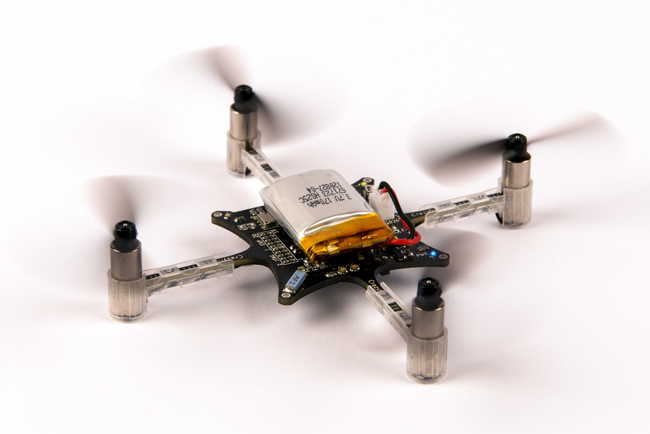
We love the quadcopters here at Digital Diner.  It seems that every day someone is doing something new and cool that involves a quadcopter one way or another.  Today is no different.  A former colleague of mine, Chris Fustings has been having fun with some very tiny little quadcopters.  The Crazyflie is a nano quadcopter from a company called Bitcraze in Sweden.  It is a slight 19 grams in weight and a mere 9 cm span from motor to motor, but still it includes sensors and controls that let it fly like the big boys.  The specs are pretty impressive.  For $120-$180 you get, 7 minutes of flight time, a low energy radio, wireless firmware updating, a 72Mhz 32bit processor, 3-axis accelerometers, gyros, magnetometers and altimeter in a cute little package that can carry a 5-10 gram payload.  Pretty impressive if you ask me.  The 10 degree of freedom (DOF) version of the quadcopter has enough sensors and processing power to do sensor fusion and stabilized flight, although the software has not yet been written (sounds like an opportunity!).

So what can you do with these?  Chris took one and added a distance sensor to it so that he could do a little obstacle avoidance.  His blog does a nice job of laying out the steps so that you can do the same should you desire.  This is a promising start, but he has dreams of doing much more.  He imagines setting up one of these little gadgets to autonomously explore and measure a 3 dimensional grid by autonomously flying to predetermined locations and taking sensor readings.  Quite cool.  Imagine fitting one of these guys out with a geiger counter (a really small one) and flying it around the Fukushima power plant to create a 3D map of radiation.  We just need some really light weight sensors and a really good method for determining 3D location.   You should get to work on this right away.


Take a look at Chris' blog post, get one of these little gadgets and have some fun!  Nice job Chris.

Monday, July 29, 2013

America's Cup Racing on the San Francisco Bay

I could only capture the two boats together at the start.
After that they were never close together again

You may recall that we went to see some sailboat racing a few months ago.  Yesterday we braved the foggy San Francisco weather again to see the Louis Vuitton Cup races on the San Francisco Bay.  If you haven't been following sailing, you may be excused for not knowing that 3 years ago team BMW/Oracle won the America's Cup in the Mediterranean Sea and now team Oracle is hosting the challengers to the oldest active trophy in international sports, here in the San Francisco Bay.  The America's Cup is a match race between two boats; the defender and the challenger.  The defender is the last winner and current holder of the cup.  They get to write the rules for the next competition.  The challenger, who will compete against the Team Oracle and the Golden Gate Yacht Club in this case, is being decided through a series of races called the Louis Vuitton Cup.  Whoever wins that series of races will compete against Team Oracle in September in the America's Cup.

I have two sporting events that I try to follow; the Tour De France and the America's Cup.  Both have been difficult to watch in the last few years.  Just as it appears that Tour De France has been decided by doctors with pharmaceuticals, the America's Cup is decided by lawyers.  There are constant challenges to the rules and court decision that have a significant effect on the outcome of the race.  It feels like something where deals are struck in smokey back rooms.  

Still, I am mesmerized and watch.  The technology in these boats is crazy.  I first got interested in the America's cup as a boy many years ago when the boats were 12 meter, mono-hull sailboats.  Now they are carbon fiber miracles with wings for sails that literally fly over the water at 40 knots (~45mph) in a 20 knot (~23mph) breeze.  When you see a 70+ foot boat "foiling" (rise out of the water) using only wind power, it is invigorating.  It is magical.  And it is over much too fast as they sail out of view.
Team New Zealand "flying" over the water
This brings us to the competition itself.  There are three contenders for the Louis Vuitton cup;  Emerates Team New Zealand, Italy's Luna Rossa Challenge and Sweden's Artemis Racing.  Artemis Racing had an accident in which their boat was heavily damaged and sadly one crew member died.  They are rebuilding their boat, but in the mean time there are only two contenders for the Louis Vuitton Cup.  Those are the two we saw this weekend.  Team New Zealand cleaned Luna Rossa's clock.  New Zealand got an advantage at the start and never looked back.  They were significantly faster on every point of sail.  This led me to the weird perspective that Luna Rossa, flying along at 35 knots, was "slow."  The boats we are used to sailing will do about 8-10 knots under ideal conditions.  This bears very little resemblance to the sailing sport that I know.

The "slower" Luna Rossa speeding across the bay
As I mentioned before, the holder of the cup gets to make up the rules for the next challenge.  These high-tech wonders are the result of something called the AC72 rule.  It defines what is allowed and not allowed in the race.  The boats and the race itself are designed to make sailing into a more interesting sport for TV.  The boats are big, fast, beautiful, shiny and extreme.  Sailing hasn't traditionally been a big spectator sport, but these boats are designed to race close to shore where we can watch the race.  The boats go so fast that they disappear from view pretty quickly, but they are still very impressive to see live.  From a spectator point of view, I think a real issue is that the competition hasn't been very exciting so far.  Because Artemis is out until they have their new boat ready, the only races between multiple boats have been between Team New Zealand and Luna Rossa.  Every time, Team New Zealand has won decisively.  It's not much of a competition so far.  I think there are a few issues that need to be addressed to make this more exciting for viewer.  The boats are so expensive that only a few of them exist.  Several challengers dropped out because they weren't able to raise the many millions of dollars to build a competitive boat.  When a single accident can cost 10s of millions of dollars, it isn't something you are going to casually make in your garage.  This limits the number of teams that compete, which in turn limits the appeal to the spectators.  Add to this the fact that the boats move so fast that boats that are even just a few seconds apart seem pretty separate on the water.  They don't interact with each other much.  Hopefully as we get further along in the competition they will be more closely matched and the competition will get more interesting.


So far, the technology involved is compelling to me, including the TV coverage on Youtube which is interesting to watch.  If you'd like to see for yourself, you can find the schedule of races here, and the America's Cup YouTube Channel is here.  Or you can watch the recording of the race that we saw live here.  I do hope the competition gets more interesting soon because this has the potential to be quite an exciting spectacle.  All I know is that in September, I expect to knock another item off my life list if I get to attend an America's Cup race live.

For the gadgeteers in the crowd, you can see an inside view of the America's Cup boats through the eyes of the Maker Camp hangout below.  They visited Team Oracle in a couple weeks ago and give you a little glimpse into the technology and expertise that goes into building a world class racing sailboat, like a sewing machine that can sew through carbon fiber sails.


For more information see the official America's Cup site or cupinfo.com


Thursday, July 18, 2013

Build a WaterColorBot and paint that masterpiece...


Super Awesome Sylvia is at it again. This time she has teamed up with the folks at Evil Mad Scientist Labs to create a printer that paints with watercolors. It is pretty clever and seems like quite a bit of fun.  They have started a Kickstarter campaing to get it off the ground, and only a couple days in they have already reached their target goal of $50,000.  Good job!

Wednesday, July 17, 2013

How the Tesla Model S is built


Here in Silicon Valley, the all electric Tesla Model S is showing up everywhere.  We have a little game we play when we go out where we try to spot as many Tesla's as we can.  It is a gorgeous car and an exciting glimpse into the future of automotive design.  One thing that you don't see on the street is how the car is manufactured.  My grandfather worked for GM, but I'm not sure he would recognize this factory at all.  The video below gives a glimpse into how the Tesla Model S is built.  I find it fascinating to watch the robots at work.


In case you are interested, I also came across this nice article for a behind the scenes look at the Tesla Headquarters

Thursday, July 11, 2013

Raspbery Pi Microwave Oven


A developer by the name of Nathan Broadband has created a Raspberry Pi based microwave oven.  Why?  Why not?  Here is a list of features according to Nathan:

  • Re-designed touchpad
  • Nicer sounds
  • Clock is automatically updated from the internet
  • Can be controlled with voice commands
  • Can use a barcode scanner to look up cooking instructions from an online database
  • There weren't any online microwave cooking databases around, so I made one:http://microwavecookingdb.com
  • The microwave has a web page so you can control it from your phone (why not), and set up cooking instructions for products
  • Tweets after it's finished cooking something (See https://twitter.com/rbmicrowave)
I particularly like the database of settings based on the barcode of the food.  Very nice.


What do you do with a Raspberry Pi powered microwave oven?  Obviously, you make a real Raspberry Pi.

Details of the project can be found here.

Nicely done Nathan!

Aero Velo wins the AHS Sikorsky Prize


Here at Digital Diner, we have showed you human powered quadcopters before.  Several of these have been built to try to capture the AHS Sikorsky Prize of $250,000.  This prize was created back in 1980 for the first human powered helicopter that could hover for one minute and reach a height of 3 meters in altitude while staying within a 10m x 10m box (complete rules are here).  For over 30 years teams have tried to win the prize and failed.  On June 13th, AeroVelo Inc was able to fulfill the requirements as seen in the videos below and win the prize.

It is interesting to me that while some teams built machines that used both arms and legs, in the end a simple bicycle style, legs only, form of locomotion won.  It is an impressive feat of engineering and human ability for sure.  Congratulatiosn to all involved!

...AND, as if that weren't enough, Aero Velo has several projects going.  My favorite is the human powered ornithopter (an airplane that flies by flapping its wings!).  Check out the video of test of this baby at the bottom of the page.


The prize winning flight

The world's first human powered ornithopter

Wednesday, July 10, 2013

How a electronic gadgets are made


I like watching machines at work.  The video above shows how the very cool development board, the BeagleBone Black, is made.  The process is pretty similar for many electronic devices these days whether it is a cellphone or a set top box.  A circuit board gets solder paste applied to it, then parts are placed on the board in the proper position and orientation by a pick-and-place machine.  The resultant assembly goes through an oven to melt the solder.  Any extra components are attached and then the unit is tested, and packaged up for shipping.

For comparison, below is a video that I made back in 2009 showing the process we used to make Sun SPOTs.  You can see that the sequence of events is very similar.  This process, on a large scale, is what  makes it possible for us to have the magical electronic devices that we have at the prices we have them.


The process you see in these videos is also partially responsible for the demise of the hobbyist electronic kit (and places like Heathkit).  The ecosystem is being optimized for the machines in the video.  The parts being placed on these boards are mostly "surface mount" parts that sit on top of the board, not "through-hole" parts that are more practical for individuals to solder.  While the surface mount parts are very small, inexpensive and efficient for the machines to deal with in large quantities, they are very difficult for people to handle with their fingers and solder manually.  Because the parts optimized for the machines have the higher volumes, the "through hole" parts are getting less common and difficult to find.  Also, because of regulations about the use of lead (RoHS), the solder has been reformulated to melt at very high temperatures that make extra challenges for hobbyists.  It certainly limits what a maker can build in their own workshop today.  It is very straight forward for hobbyists to get a printed circuit board made, but getting the parts put onto it can be a difficult and/or expensive proposition.

The forces of nature that are moving the world in this non-hobbyist friendly direction are fairly strong and not likely to change.  The question is how can hobbyists and makers take advantage of this manufacturing technology when building in small numbers?  I think there is hope.  It might not make sense for you to have a pick-n-place machine in your garage,  but there could be inexpensive mail-order services that will stuff the parts in your boards for you.  The difficulty is making this cost effective for us hobbyists.  Loading up the proper parts in a pick-and-place machine is a very manual process.  The different "reels" of parts must be loaded up and programmed into the computer so that it knows where to find the appropriate parts.  When you are building thousands of boards, this preparation time is not a problem.  When you are only building a few boards, this set-up can cost much more than the build.

What is needed is a system that lets me, a hobbyist, spend my own time preparing my parts for the production run.  Better yet would be a system where the parts are delivered from the parts supplier to the fabrication house in machine readable, and robotically manipulatable packaging that works for small numbers of parts (not a reel that has thousands of parts).  If the parts could be automatically loaded into the machine, and I could spend my own time preparing my design for the placement machine then the preparation costs could be minimized.   If we can find a good way to cut down on the set-up costs, I'm certain a new age of custom electronics manufacturing will be on its way.   In the mean time, I think I'll just watch the videos a few more times.