Thursday, May 30, 2013

Super Awesome Sylvia hearts you


The latest from the ever-effervescent Super Awesome Sylvia has you building a necklace that displays your heartbeat.  I think it could do with some more elegant packaging if you wanted to wear it on a regular basis, but I really like the idea of biometric jewelry.

If you haven't experienced Super Awesome Sylvia, it is worth your while to check out her site.

Wednesday, May 29, 2013

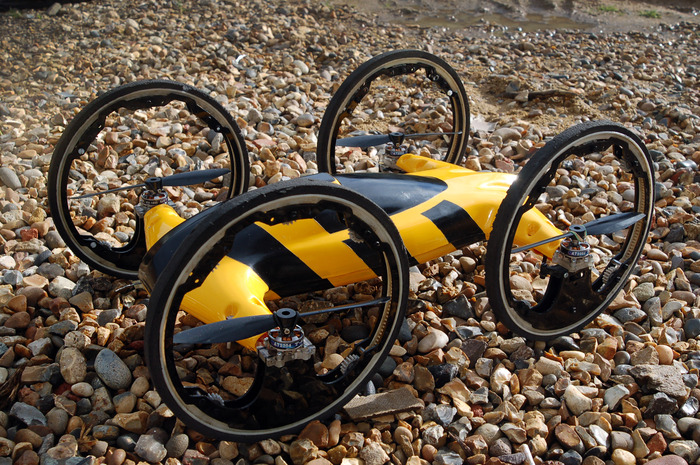
I've never seen a flying car like this before


This is a rather unique model flying car.  It is both a wheeled vehicle and a quadcopter.  Some of the design ideas are really interesting.  For example, this is the first time I've seen anyone use the space inside a hubless wheel effectively (in this case to hold the quadcopter propellors).  The wheels and props are flexible and nearly impossible to break.  It may not be the best car or quadcopter I've ever seen, but it is certainly the best combination of the two I've ever seen.


See the Kickstarter here.

Tuesday, May 28, 2013

This is an impressive analog device


Sometimes when people get caught up in all the maker hype these, they forget that back in the day, people with real mad skills made awesome stuff.  While it's always great to make stuff, before the days of Arduinos and PWM controlled of servos, people used to create mechanical masterpieces.  More intricate than the geekiest algorithm is the design of a spring loaded, hidden compartment.  This cabinet is one of the finest examples I've seen in a while.

The Berlin Secretary Cabinet was built in the 1700s in Germany and was owned by King Frederick William II.  It is on display at the Metropolitan Museum of Art in the Extravagant Inventions exhibition.  It was built by Abraham Roentgen (1711–1793) and his son David (1743–1807).  Nicely done gents!

Thanks Opa!

A chocolate zoetrope seems like a really good idea until you realize you can't eat it...


The Philip Island Chocolate Factory near Melborne, Australia has a pretty interesting attraction.  It is a zoetrope made of chocolate.  The delicious sculptures rotate on a disk synchronized with a strobe light to create an animation effect that is quite impressive.  Because video frame rates don't synchronize exactly with the strobe, there is an ugly line in the video while it is flashing that you would not see if you were watching this in person in Australia.  Still, it looks very impressive.  I do, however, question the use of perfectly good chocolate on a non-edible artwork.


via This is Colossal

Riding in style


OK, I want this for my bike.  I've seen these around and they seemed kind of fun, but somehow the cartoon dog chasing a cat brings it to a whole new level.  Its not like I ride my bike at night that often... but, this looks fun.
The idea is to combine 4 LED bars on your spokes with an accelerometer and some software to create persistence of vision tricks for the amusement of those around you.  The Monkey Light folks have a Kickstarter to get off the ground.  The only problem is that it's a more than a little bit pricey at $500/wheel to outfit your bike.  Still, it ranks high on the awesomeness scale.


Using the sensors to control what is displayed looks pretty cool too, although it is usually the people in front of and behind you that really need to know your intensions.

Still, nicely done Monkey Light Pro.


Monday, May 27, 2013

Congratulations Team Awesome!

Congratulations to the "Awesome Is What We Totally Are" Team for meeting their fund raising goal.  For those of you who have not been following along, Team Awesome, is a group of kids who are on a quest to help people find their inner awesomeness by "making what matters."  They have been raising money through Piggybackr (a fund raising site for kids) to help offset the costs associated with teaching their classes on aeroponics.

Among other things, the kids promised to run some laps for people who donated enough money.  The video below is their proof to the donors that they actually ran.  Looks like fun to me!


Team Awesome on Piggybackr

Wednesday, May 15, 2013

Can numbers be illegal? Should they be?


Can numbers be illegal?  We, as a society, are still figuring out the implications of the digitization of the world.  The video above shows a seemingly silly example of how bizarre the information age is becoming, but the issues are real and complex.

Many of the technologies we create reach far beyond their intended scope.  As sorcerer's apprentice, we find ourselves scrambling to keep our own creations under control.  More and more of the value that we create is intellectual property rather than physical goods.  Keeping control of these intangible creations is rather complex.   Because much of what we create is virtual, it can be represented as bits that ultimately can be represented as numbers.  When many things can be reduced to numbers, we are likely to start running into unintended collisions where unrelated things may reduce to the same number and cause conflict.  The basic issue here is our inability to separate intent, source and use of information from its representation.  It is a difficult problem.  After all what is the intent of a number?  How can we determine a number's genealogy?

I remember some time ago a group tried to test this out in a peculiar way.  Certain encryption algorithms are treated as munitions (weapons) and can not be exported from the country except in very controlled situations.  This group of people decided to attempt to organize themselves on a beach in Santa Cruz in a way that they represented the bits of an encryption algorithm just as a Russian spy satellite went over head.  Theoretically, they would be illegally exporting a weapon.  (In fact at the time of this exercise, the Russians had the same or similar encryption techniques, so it wasn't actually very significant)  They were never successful in gathering enough people to actually carry this out as far as I know, but if they did, would they be breaking the law?  On the one hand, they would be potentially illegally transferring information out of the country.  On the other hand, they were just a bunch of geeks on the beach.  Are we going to make specific configurations of people on the beach illegal?  How about orientations of cars on the road or plants in a field?  What if you accidentally created one of these patterns in your back yard?  It seems silly to expect that we can keep such things under control.

There is also big money in these numbers.  In the case of music and film, once it is digitized, all the value of these artistic creations (potentially many millions of dollars) is tied up in something that can be represented as a single, really large number.  In order to encourage the creation of more books and music and films, we need to provide the creators with some control over their works and some way for them to be fairly compensated for their use.  This has gotten us into a complicated mess of Digital Rights Management and the Digital Millennium Copyright Act.  Oy!

We here at Digital Diner love 3D printers and are very excited about the possibilities they create.  Of course many other people are interested in the same thing, including a fellow named Cody Wilson, who wants to distribute the information required for you to print your own weapons.  He has created a computer model that can be fed into a 3D printer to create a working gun.  See the video below for more information.  Is this a good thing or a bad thing?  Technology and opportunities often come at a cost.  It is hard to understand the implications of our creations before we create them,


I'm fairly certain that there could exist an encoding scheme whereby the position of the hairs on your arm could represent the exact text of a top secret memo or the plans to a nuclear missile.  The scheme I'm envisioning would be a very complex piece of software, but combined with a picture of your arm, or a map of the location of the hairs on your arm, it cold reconstruct particular secrets messages.  Obviously, much of the complexity would be in the software and one could argue that it contains the secrets.  But just consider the complexity of the satellite system that the Russians would have had to use to decode the encryption algorithm of geeks on the beach.  One could argue that they already had much of this secret and just needed these few bits represented by the location of the people on the beach to fill in the holes just as my computer program just needs the hairs on your arm to fill in a few blanks.

As I said at the beginning, this is a complex issue.  On the one hand we have seemingly ridiculous things like illegal colors companies patenting genes.  On the other hand we have complex issues of proliferating secrets and the protection of intellectual property.  It will likely take us some time to sort all this out.  I know it gives me a headache.

Sunday, May 12, 2013

A true Space Oddity. Very nice job Commander Hadfield!


You've been onboard the International Space Station for months and now its time to come home.  What do you do?  If you are Commanded Chris Hadfield, you record an awesome version of David Bowie's song Space Oddity while you are still in space.  Whoa!  That's a whole lot of awesome right there.

Safe trip home Commander Hadfield!  I expect to hear a version of Homeward Bound during the re-entry.


BTW, If you like this video you may be interested in Command Hadfield's top ten videos from the ISS

Happy Mother's Day


Here's one for mom (which is wow upside down)!

Love you Mom!

Friday, May 10, 2013

Scratch 2.0 gives everyone a chance to have fun while learning to program.


Scratch from MIT has been a favorite around Digital Diner for years.  It is an engaging interactive programming environment that both of our kids had fun playing with and learning the programming skills that have allowed them to move on to more advanced projects.  It is attractive to kids because it is so fun that you don't even know may not even realize that you are learning to program.  Any of you adults who have been interested in how to program computers might want to give this a look as well.  It doesn't take much to get started.

The folks from MIT have just announced Scratch 2.0.  It allows anyone to start playing with Scratch from their web browser.  There is no software to install.  Just head over to their web page and follow the instructions to get started.

Scratch 2.0 also includes some new features that allow users to take their skills further and make it even easier to share your work with the community to show off all that you are learning.  They have even included an interface to a webcam that lets you interact with your program by waving your arms around.  Pretty fun!

It is a great way to learn and play.  If you have any interest at all, I encourage you to head over and check it out.